
Work meetings can propel a company into success. Alternatively, they can be a dull, sometimes irrelevant social gathering that consumes valuable productivity time. We’ve all been in meetings where we sit and wonder “what are we really doing here?” or “this could’ve been an email”.
Here are some interesting data:
- It’s estimated that in the US, $37 billion is lost annually due to unproductive meetings.
- Employees spend 31 hours per month on average in unproductive meetings.
- 78% of employees report that they are expected to attend too many meetings. As a result, their actual work becomes too challenging to finish.
Properly planned meeting can extract extreme productivity from enthusiastic teams. Meetings are excellent for many reasons, like to brainstorm solutions to challenges, develop new ideas or give direction. To guarantee productivity you need to make sure you have the right game-plan to assemble your ultimate meeting.
DECISION: Is The Meeting Necessary?
First step is to decide whether a formal meeting is necessary. Is it extremely necessary to have the staff meeting daily or can you check in a few times a week? Perhaps it can be an conversation in a lesser formal setting like over morning coffee?
Consider these questions when deciding on a meeting:
- What are the clear goals or deliverable outcomes required?
- Does this topic need outside contribution for development? If so, do you have the required information on hand?
- Does this topic need a face-to-face conversation, and if so, who should be included in this conversation?
- Will this meeting include valuable use of time for the employees?
THE PAT APPROACH
Purpose, Agenda and Time frame.
The PAT approach is a good tool to use for efficient meeting management. All meetings should have these three elements.
Purpose: Why are we having this meeting? State this in one short sentence.
Example: “The purpose of this meeting is to decide on a solution for recurring distribution challenges in the trade.” Stating a purpose allows participants to evaluate whether they need to be there. It will also help you to build the agenda to decide whether the meeting was successful.
Agenda: The backbone of the meeting. Create an agenda in advance and send to all participants and observers. The agenda should be used throughout the meeting to keep things on track.
Time frame: How long should this meeting last? Typically, meetings shouldn’t exceed one hour. Should it be longer, make sure you include breaks or divide it into two or more sessions.
CONSTRUCTING THE AGENDA
Before the meeting, make a list of:
- what needs to be discussed
- how long it should take
- the persons who will be presenting each item
Example:
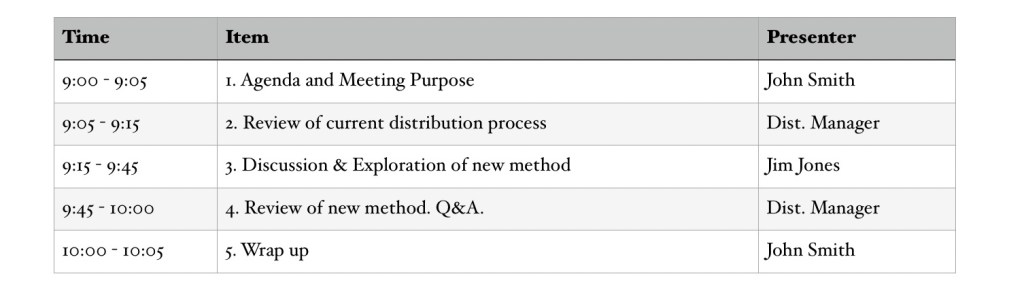
Once your agenda is finished, send it to all participants of the meeting. It’s preferable to send it with a meeting invitation at least 2-3 days before the meeting. Make sure you seek everyone’s consent for their part on the agenda.
STAYING ON TRACK
Before the meeting, post the agenda on a flip chart, white board or PowerPoint presentation slide. Spend a few minutes to go through the agenda at the start. Emphasize productivity and the time frames allotted.
During the meeting, minutes can be taken using the agenda as a frame work.
Example:
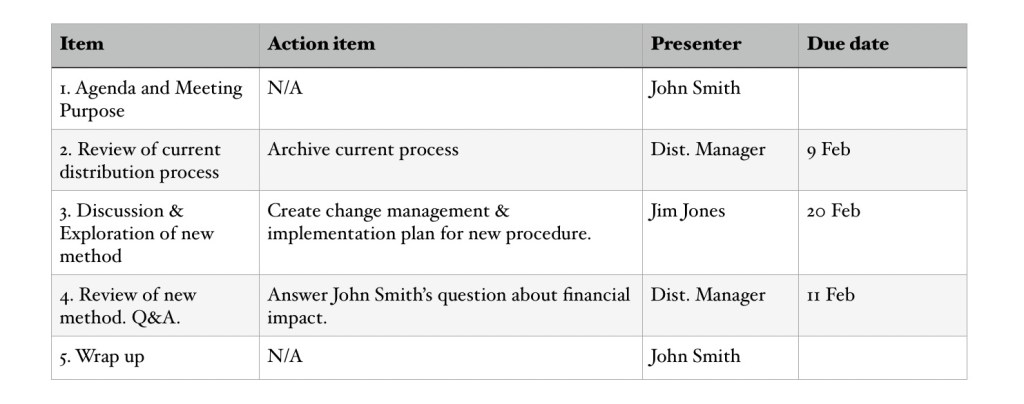
Note: this is an example of a lesser formal structure of meeting minutes. More formal meeting require more formal minutes.
ROLE OF THE CHAIRPERSON
As the chairperson your job is to keep the meeting running according to the agenda. If an item goes pass the allotted time, ask the group whether they need more time to discuss. Alternatively, inquire whether to continue to the next item. In some cases where there is a stalemate, you need to take the initiative and decide unilaterally.
In cases where important matters need the attention, you can:
- Reduce the time for other items.
- Remove items altogether.
- Schedule a follow-up session.
At the end of the meeting, get an agreement from participants. Confirm that all the items on the agenda were sufficiently covered. This will reveal gaps that need follow-up. It will give persons a positive sense of accomplishment after the meeting.
MAKING SURE IT WAS WORTHWHILE
To guarantee a successful close to a meeting, it’s advisable to touch base and track progress of action items. After the meeting, send out a summary of the action items to everyone that was involved.
Action items should clearly show start and end dates, and progress dates if applicable. If a follow-up meeting is necessary, that should be scheduled.
It’s important to always seek feedback after a meeting. Ask your participants whether they found the meeting valuable, or on what can be improved. The feedback is useful for the preparation of future meetings.
Here’s a practical illustration of time management within a meeting:
John Smith glanced at the clock on the wall of the meeting room. It was 9:35 a.m. He chaired the meeting. It seemed they were going over the allotted time for discussing one of the agenda items.
He addressed the participants. “This is an eye opening discussion on our current distribution system. We’re about to run out of time for this agenda item. This is an important conversation. But, our time is limited.” Should we end this discussion and move on? Or should we continue with this discussion but reduce time for the other items? Or would you rather schedule a follow-up session?”
The participants shared their suggestions. It was agreed that they’d continue the discussion for five more minutes. Then, they would reduce the time spent on another topic. This gave the deciding power to the participants and also kept the meeting on track.
SUMMARY
There isn’t a one size fits all approach to hosting effective meetings. Proper planning, accountability of time, and evaluation make for a productive session with your team.
PAT (purpose, agenda, time) Framework, Agenda Planning, Action Plan & Evaluation are all useful tools. They guide you on your path to effective meeting management.

 The Journey & The Grind
Leave a comment